ROXTAR - Online marketing

What is Link Building?

Link building is getting links from other websites to yours, so search engines like Google see you as a trustworthy authority. Those links are called backlinks. The more relevant and reliable websites refer to you, the better you can rank in the search results and the more relevant visitors you attract.

When you build a website, you naturally want people to find it. Whatever your reason for building it, a website without visitors is not worth much! Ideally the right audience finds its way to your site as well. To make that happen, you will have to put real work into your website. Your content has to be good, but link building is also an important part of a strong website, which is why outsourcing link building is a good option.

Online visibility often feels like a whole new world, but for businesses and institutions it has always mattered. In the physical world it is just as important that people know where the town hall or museum is, or that a shop is in the right location. As a shop owner you do not settle at the end of a dead-end street; a busy spot where lots of people walk past makes much more sense.

The same applies on the web. If your website sits on page 20 of the Google results, that is the dead-end street. If you show up on the first page for several search terms, you have a good spot, like a shopping centre or a prime location in the city centre.

In this article we explain what link building is and how it works. Many website owners pay no attention to it, which is exactly why it is a big opportunity to rise above the competition. Link building means growing your link profile, so search engines like Google see you as a stronger authority. You do this by earning more quality links to your website, with the goal of ranking better in Google and other search engines.

Link building only works as part of a well-thought-out approach. See how we do that at outsourcing link building, or see the full picture at outsourcing SEO.

When people think about optimising a website, they often think of SEO. SEO stands for search engine optimisation. SEO improves a website in several ways, link building being one of them. It takes three factors into account:

Technical: This factor is about the experience of the search engines themselves. The visibility and functioning of your website matter a lot, as do indexing and crawling (the process in which a search engine looks for new information). The structure and speed of the website count as well.

On page: This is about being found in search engines. The criteria are adjusted regularly, so your website has to stay in good shape from an SEO point of view. Besides text, videos, photos, audio and invisible content such as HTML tags are also taken into account.

Off page: This factor is about authority, relevance and trust: SEO factors that are not on your own website. Link building is an important part of it, along with various forms of marketing and user generated content that create external links to your website.

Wat is linkbuilding

Link building is one of the most important activities in targeted SEO. When you earn backlinks, search engines notice that you do more than just publish content, and your authority grows. But more backlinks do not guarantee success: the links have to be targeted and of good quality. A link from a large, authoritative platform helps you rise faster than lots of small links, and relevance counts too; a link from an unrelated site adds little. Want to know more? Take a look at our services or get in touch with no obligation.

Because search engines focus heavily on links, link building keeps getting more important. In the past there were tests where social media, for example, was an important factor: the better a website scored there, the better its search results. That method, however, was easy to manipulate.

That is why backlinks are still an important ranking factor. Google does pay much closer attention to the type and quality of links nowadays. One advantage of backlinks is that your audience can find your website in different ways: if a website in the same niche links to you, visitors reach your site through that route.

More visitors to your website!

Backlinks on other websites are one way to get more visitors, but there are more. The most important one is landing on the first page of the search results, and especially in the top positions, because those get noticed first. Unfortunately, those spots are hard to reach.

Link building is a very important way to reach those top positions anyway. Large companies invest a lot of money in it, which smaller businesses cannot match. That is why more creative and targeted link building is crucial, and that is where ROXTAR helps you. We make sure your website can be found through different websites, so your audience finds you more easily.

Interne en externe links bij linkbuilding

In link building we roughly distinguish two types, and both matter for taking your website to a higher level.

Internal link building: links to other articles on your own website. Ideal if you have not built much authority yet. Note: internal links have to be relevant too.

External link building: links from other websites to yours. These largely determine your ranking. Make sure relevant sites in your niche are happy to link to you, for example through guest blogs. The more relevant websites refer to you, the higher your authority, and in the end more visitors and revenue.

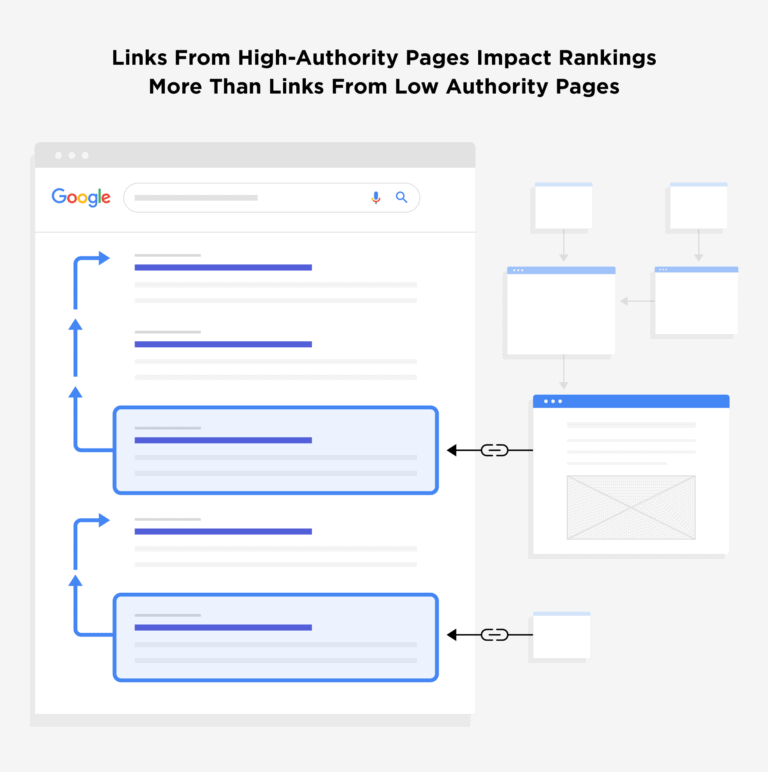
Effect van pagina's met hoge autoriteit op linkbuilding

Relevance and authority

Relevance and authority are at the core of link building. Links from relevant websites in your niche make Google see you as more relevant, which improves your ranking. Authority counts heavily too, of the backlinks and of your own site. Sources such as governments, schools, research sites and Wikipedia are seen as trustworthy; when they link to you, Google knows you are a reliable player. Examples of authoritative sites: Rijksoverheid, Wikipedia, Harvard and Microsoft.

A strong backlink profile consists of links from relevant, reliable websites that have built up naturally over a longer period. So it is not about the number of links, it is about the mix.

  • Relevance. The websites that link to you cover the same topic or serve the same audience.
  • Authority. The linking websites are strong and reliable themselves, such as trade media, industry associations and well-maintained blogs.
  • Spread. You get links from many different domains, not ten links from the same website.
  • Natural anchor texts. The clickable text of a link varies: sometimes your brand name, sometimes a topic, sometimes simply “this website”. Exactly the same keyword everywhere looks unnatural.
  • Gradual growth. Your link profile grows steadily along with your reputation, instead of hundreds of links at once.

Links from link farms, bought link packages or websites with no connection to your topic add little. Google usually ignores such links, and with large-scale link schemes Google can even impose a manual action.

An example from practice. Say you offer a local service and want to rank higher for an important keyword. First we make sure your most important service page gets stronger internal links from your own blogs and pages. Then we arrange external links through relevant local platforms and industry websites. That way your authority grows on exactly that topic, and your positions for that keyword rise.

That works better than collecting links on random websites. A handful of links from your own niche often does more than a pile of links from sites that have nothing to do with you.

Link building makes Google see you as a stronger “authority” in your market: you get more quality links pointing to your website. A website with more authority also ranks better. Questions about this? Get in touch and we will make your website fully SEO-proof.

What do you mean by “authority”?

Authority is Google’s way of saying that you are a big and therefore reliable player. If you attract a lot of attention, Google notices and sees you as a stronger authority. You can check the authority of a website with SEO tools.

So what is “relevance”?

Relevance, as the word says, is how relevant the link is. If you get a link that has little to do with your website, Google barely counts it. Google nowadays knows not only how often you are mentioned, but also how relevant that is. If you run an IT shop and get a link from the potato farmer around the corner, it does not help much. Combine relevance with authority, and you get a good “PageRank”.

You see it in rising positions in Google, more organic traffic and a growing number of relevant referring domains. Often you also get direct traffic through the websites that link to you.

Do expect to be patient. You usually only see the effect of a new link after a few weeks to months, because Google first has to revisit the linking page. So measure per quarter, not per week. The most important thing remains: not more links, but better links that fit your niche and goals. Want to hand it over? Read more about outsourcing link building.

Curious what impact we can have on your online presence? Get in touch with no obligation. We are happy to go through your website together.

Free SEO check · See your opportunities quickly · Personal conversation with one of our advisers

Successful SEO makes a site attractive to users and search engines. It is a combination of technology and marketing that brings you more traffic and therefore more customers. Want to take your online marketing to the next level? Request a free strategy session now.

Link building means building links from other websites to yours. Google treats those links, backlinks, as recommendations: the more reliable sites refer to you, the higher your trust and your position. Quality and relevance weigh more than numbers.

You make sure relevant, reliable websites link to your pages, for example with valuable content, guest articles or mentions. Google sees every good link as a vote for your site. A link from an authoritative, relevant site is worth more than dozens of weak links.

Yes. Google still uses links as an important signal of authority and trustworthiness. Quality, relevant links from strong websites help you rank higher. What has changed is the emphasis on quality over quantity: a few relevant links weigh more than dozens of weak ones.

Link building is building references, or backlinks, from other websites to yours. Google sees every link from a reliable and relevant site as a recommendation. That builds authority, which leads to a higher position in the search results.

Want to get started with this yourself?

We are happy to think along with you, with no obligation, about what works best for your situation.

Talk to a specialist

Laatst bijgewerkt: